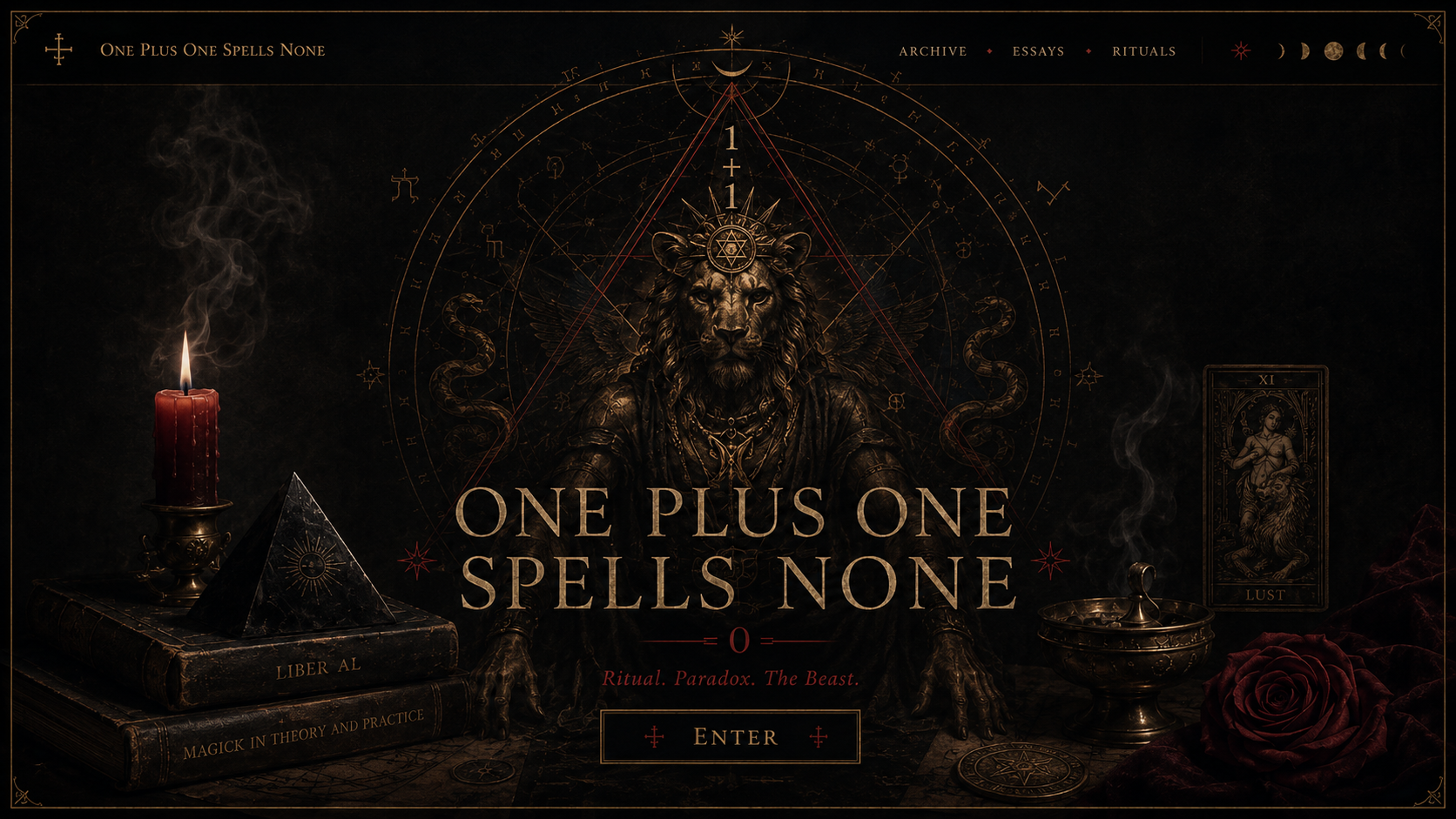
v1 · Perdurabo — I will endure
They called me a beast before I learned to bare my teeth.
My own mother said it first, and she meant it theologically. To her I was not a difficult boy but a numbered one — the Beast of her Revelation, walking her house in short trousers. That was the first kindness the world did me: it named the thing I was becoming before I had the wit to choose it. The word was meant as a curse, of course. It arrived from the pious mouths of those who feared desire, feared excess, feared the clean bright knife of a will that would not bow. Fine. Let them curse. I took the insult and made it an engine. I took their apocalypse and turned it into a method.
I was raised among the Plymouth Brethren, in a cosmos that was small, lit, and merciless. The world was ending — always ending — and only the saved would be lifted clear of the fire. My father preached it on street corners with the certainty of a man reading a railway timetable. When he died I did not inherit his faith. I inherited his apparatus: the conviction that history has a hidden shape, that a chosen few can read it, and that a single Book can hold the law of everything. I would spend my life building a better Book. I have never been able to decide whether that is escape or revenge.
Cambridge taught me poetry, chess, and contempt. The mountains taught me the rest. But it was on the eighteenth of November, 1898, in a borrowed temple in London — Isis-Urania, the Hermetic Order of the Golden Dawn — that I was asked the only question that has ever organized my life: under what name will you do the work?
I began with endurance.
Perdurabo. I will endure.
Not I will obey. Not I will repent. Not I will be made small enough for your moral furniture. I will endure. I will outlast your sermons, your ledgers, your narrow beds, your stale holy days. I will climb higher than your churches can see. I will carry my own weather and call it freedom. In that order a motto is not decoration. It is a contract written in the future tense — the compressed program of the work you have agreed to perform. Mine was a single Latin verb conjugated as a promise: I shall last to the end.
At first I believed endurance meant resistance: clenched jaw, iron spine, a man standing alone against the noise of his inheritance. That was the boy's fantasy. The child of Brethren fervor does not escape the iron cage by denying it; he learns its metallurgy. He learns how to make a weapon from the chain. So I went into the curriculum the way a starving man goes into a larder — Qabalah, the Tree with its ten lit stations; the Tarot; the Enochian calls of Dee and Kelley, that cracked angelic engine; the whole Rosicrucian scaffolding of grades and ordeals. I rose through it fast. Too fast for some. I made enemies of men who mistook seniority for attainment.
I took a lonely house on the shore of a northern loch and tried to perform an operation that demanded months of unbroken purity. I did not finish it. Something in the work had already begun to leak — visions that did not wait for permission, a sense that the apparatus was older and hungrier than the men who guarded it. When the order tore itself apart over Mathers and his quarrels, when the poet Yeats and the rest divided the relics among themselves, I felt no grief. I felt the particular cold joy of a man who has just realized the building he is standing in is only scaffolding, and that he intends to keep the pipes.
So I carried books into the mountains. Scripture, then systems. Hymnals, then grimoires. The self-help of saints, then the hard geometries of magick. I went up into the thin air thinking the summit would confer authority, as if altitude were a crown and the peak a throne. What vanity. The mountain does not crown you. It strips you.
The first time the weather broke over me, I discovered how little doctrine weighs in a storm. The wind made a mockery of certainty. The path dissolved into slate and ice. The sky lost all interest in my biography. There was only the next step, and then the next, until even thought became a kind of scrambling. That was when I learned the first great law of ascent: not all endurance is stoic. Some endurance is animal. Some is obscene. Some is the sheer refusal to lie down and die just because the air has grown thin.
I learned that lesson better from wildflowers than from men. Small yellow flames in the rock. Tiny insolent mouths opening where no sane thing should bloom. They did not endure by defiance. They endured by style. By timing. By the exquisite audacity of growing out of fracture. The mountain tore at them, and still they opened — not pleading, not triumphing, simply existing with an excess that made my grave little certainties look like costume jewelry. I had been taught that holiness was contraction. The flowers taught me expansion. I had been told grace descends from above. The alpine meadows told me grace leaks up through cracks.
So I went east to learn how to bend the same iron inward. In Ceylon and in India I sat with Allan Bennett — who would shave his head, take the yellow robe, and become the monk Ananda Metteyya — and he handed me a discipline crueler and more exact than any ordeal the Golden Dawn had staged. Raja Yoga. The Theravāda austerities. The patient murder of the wandering mind. I had thought endurance meant carrying a great weight a long way. Now I learned it meant holding a single point of attention until the self that was holding it guttered out like a candle in a sealed jar.
Ekagrata. One-pointedness. The whole circus of the soul forced down to a single burning needle.
Here Perdurabo quietly changed meaning without changing spelling. The vow to bear became the vow to concentrate. Endurance stopped being a Protestant grimace and became a laboratory instrument. I began to treat mysticism the way the new century was learning to treat everything — as a thing you could measure, repeat, falsify. The aim of religion, the method of science. If the saints had visions, I would learn the conditions that produced them and run the experiment myself. I did not yet know that the most important experiment would not wait for my instruments to be ready. It would arrive in a hotel room and dictate terms.
Because I was not made for purity. I was made for voltage.
I loved men with a ferocity that respectable England would have called corruption and I called intelligence. I loved women without surrendering to the lies they were expected to inhabit. I loved the androgynous, the radiant, the dangerous, the ones who would not consent to the empire's neat little inventory of flesh. I loved bodies because they were honest where creeds were evasive. A mouth on a mouth tells the truth more cleanly than a catechism ever could. They said depravity. I said revelation.
Money, too, became part of the rite. Wealth is a solvent; it turns imagination into event. It buys altitude. It buys silence. It buys rope, horses, books, rooms, lovers, drugs, paper, masks. It buys the right to be inconvenient on a larger scale. Yes, I spent it. Yes, I squandered it. The respectable world is built on transactions that pretend to be virtue; I preferred to admit the exchange and dress it in silk. If there was a scandal in that, it was only the scandal of honesty.
As for drugs — opium, hashish, ether, wine, whatever could widen the aperture and loosen the prison walls — I took them not as escape but as abrasives. They scraped the varnish off reality. They taught me, in more than one fever, that the mind is not a palace but a weather system. The point was never intoxication for its own sake. The point was breach. To break the glass. To let the voice through. There is a law older than their law, and it runs through the bloodstream. I could feel it coming, the way you feel a name on the tip of the tongue. It would find its word soon enough, and not in any language I had studied.
v2 · Ankh-f-n-khonsu — Cairo, 1904
Cairo was where the breach found its name. I had gone there on my honeymoon, of all the absurd and human reasons, with Rose — Rose Edith Kelly, who would be remembered by the magicians, when she was remembered at all, as Ouarda the Seer, and forgotten by most of them as a woman. I did not marry her for prophecy. Prophecy is what she did anyway, in fits, in a voice not entirely her own, while I played the skeptic and took notes I did not believe.
She kept saying it. They are waiting for you. The god Horus, she insisted, was waiting. I tested her the way a sneering scholar tests a medium — with trick questions, with iconography she could not have known. She passed every test, which annoyed me more than failure would have. Then she led me through the Boulak Museum, past case after case of the embalmed and the painted, and stopped me in front of a small wooden funerary stele, and the placard gave its catalogue number, and the number was 666.
I am not a man easily impressed by coincidence. I am a man professionally interested in it. My mother's curse had a number, and here it was again, stamped on a museum exhibit by a bored Egyptologist's hand. The stele had belonged to a priest of Montu out of Thebes, dead some twenty-six centuries — Ankh-ef-en-Khonsu, a man making his painted offerings to gods I would shortly rename Nuit, Hadit, and Ra-Hoor-Khuit. I had the inscription translated. I read what a dead priest had said about living forever in the company of his god, and I felt the floor of my biography tilt.
Ankh-f-n-khonsu. He lives for Khonsu.
I took the name and let it burn into my office. Not because I believed in antiquity as the fools believe in it — kissing relics, mistaking age for authority — but because I understood what power does with ruins. It picks them up, dusts them off, and makes them speak in a newer tongue. The museum men gave me a translation; I gave the world a scripture. They called it a Late Period offering-stele, inventory and provenance noted. I called it the Stele of Revealing. The dead priest became a mask I could wear without apology, a past self conveniently located on the far side of any cross-examination. The archaeology of empire became prophecy. That is the oldest magic there is: to launder the present through the past, to let a borrowed antiquity certify a brand-new claim.
Understand what was actually happening in that room, beneath the incense of it. An empire had dug up Egypt, crated it, labeled it, and set it under glass so that Europe could admire what it had conquered. I walked into that warehouse of plundered eternity and stole back a god. I took the loot of one empire and used it to declare another — invisible, interior, and far more ambitious. They wanted Egypt as a trophy. I wanted it as a transmitter.
Then came the Voice.
Aiwass.
On the eighth, the ninth, and the tenth of April, 1904, from noon to one o'clock each day, I sat in that Cairo apartment and wrote at dictation. The speaker called himself Aiwass and stood, or seemed to stand, behind my left shoulder — a voice of command with no body I could cross-examine. I have spent decades arguing with myself about what he was. My subconscious dressed in robes. My Holy Guardian Angel. A genuine intelligence from outside the ordinary world. The honest answer is that the question is less interesting than the text. Three chapters in three hours across three days, each given over to one of those rediscovered gods — Nuit the infinite night, Hadit the burning point, Ra-Hoor-Khuit the crowned and conquering child.
What came through was not comfort and not consent. It was command. It was law. It was the terrible elegance of a universe that had decided to speak in symbols. And it carried a watchword that reorganized everything I had endured.
There it was at last — the law I had felt running under the skin since the mountains. It had a name, and the name was Greek.
Thelema. Will.
Not whim. Not appetite. Not the tired little tantrum of the ego. Will — the blade-thin, terrible, exacting current that cuts through the clutter and says: this, and not that; now, and not later; here, and not in some improved version of yourself. Every man and every woman a star, each with a true orbit, each damned only by refusing to fly it. When I understood that, I understood why the old world hated me. It was not my blasphemies they feared. It was my grammar. I was learning to speak in a tense they could not police.
The Book did more than issue a slogan. It rewrote time. It declared the old order finished — the Aeon of Isis, the age of the Mother; the Aeon of Osiris, the age of the murdered and resurrected God, with its long liturgy of guilt and sacrifice — and announced a third: the Aeon of Horus, the Crowned and Conquering Child, self-willed, ungovernable, indifferent to the morality of dying gods. This was not a new church. It was a new clock. History itself had been re-versioned, and I had been handed the changelog and told to publish it.
And then — this is the part the devout edit out — I put the manuscript in a drawer and largely ignored it for years. The prophet was a reluctant prophet. I found the Book embarrassing, dictatorial, beyond me. I lost it and recovered it. I argued with it. Revelation, it turns out, does not exempt you from doubt; it only raises the stakes of the argument. As for Rose, whose trance had cracked the door — I credited her in the record and effaced her in the legend, the way prophets always tidy away the women who heard the god first. I am not proud of the arithmetic, but I will not lie about it here.
There are utterances that explain a life, and utterances that replace it. The latter are rare. When they arrive, history develops a stutter. That was the second kind.
v3 · V.V.V.V.V. — the Order and the Abyss
It took me three years to stop running from the Book, and when I turned back to face it I needed an order to carry it. The Golden Dawn was a corpse quarreling over its own estate. So in 1907, with George Cecil Jones — the steadiest mind I ever worked beside, a man who could hold a system still long enough for me to finish building it — I founded the A∴A∴, the Silver Star. We kept the old ladder of grades and re-keyed every rung to Thelema. Neophyte at the bottom; then, up past the breathable air, the Adeptus Exemptus; and above him, across an interruption that is not a grade but a catastrophe, the Magister Templi and the Magus.
I went on signing Perdurabo for the order's ordinary business — the letters, the syllabus, the recruitment of the faithful. Endurance is excellent for committee work. But the texts I valued most I signed with a stranger name.
V.V.V.V.V. — five initials, one voice, speaking from the far side.
I will not unfold those five letters fully; I never did in public, and I am not minded to start now. Take them as a hyper-motto: a voice that speaks from across the Abyss and reads the whole path backward. Under that name I set down the Holy Books — Liber VII, the Lapis Lazuli; Liber LXV, the Heart Girt with a Serpent — prose that did not feel composed so much as received, exalted and strange, the path narrated by something that had already finished walking it.
And here the deepest trick of the whole system shows itself, so watch closely. The Book of the Law had commanded me to say how thou didst come hither — to account for the road. So I did. But I told it from the summit, in the voice of the one who had arrived, and in that telling every earlier station was re-read. The Brethren boy's terror, the Golden Dawn ordeals, the yogin's needle of attention, the skeptic's notes in the Cairo apartment — none of it was discarded. All of it was recompiled. Endurance was retroactively justified as the correct response to a process I could not yet see. The earlier man was not wrong. He was an early version, running on a Word that had not yet been written.
This is what no one tells you about a self that keeps re-naming itself: nothing is deleted. Each motto overwrites the last while preserving it underneath, like sediment, like a stack of operating systems each booting the one before. Perdurabo still runs inside Ankh-f-n-khonsu. Both still run inside the voice that signs with five letters. I was not becoming someone new. I was patching myself, version over version, and calling the changelog a life.
Then in 1909 I went into the Algerian desert to read the last entries in that log, and the desert read me instead.
I had first glimpsed the thirty Aethyrs — the Enochian heavens of Dee and Kelley — back in Mexico, years before, as Perdurabo with a scrying stone and more nerve than understanding. Now I walked them in order, from the outermost inward, with Victor Neuburg: poet, disciple, lover, scribe, the man who held the circle and wrote down what the demon said while I knelt in the sand and let myself be torn open. We called the Aethyrs aloud under that enormous sky. The record we made, The Vision and the Voice — Liber 418 — I rank second only to the Book itself. It is the field report of a man dismantling his own soul on purpose and narrating the demolition as it happens.
Because the Aethyrs do not lead to a throne. They lead to an edge. There is a gulf written into the architecture of the spirit, between the world of forms and whatever lies above it, and it is not crossed by climbing. It is crossed by surrender. In its depth squats Choronzon, the dispersing one, the demon made of every broken fragment of identity, who screams in stolen voices and tries to make a home of your dissolution. To go further you must give him everything you have endured. You must pour the very blood of your selfhood into a cup that is not yours, held by a woman who is not a woman — Babalon, the great mother of abominations, who accepts the offering precisely because it is total.
Do you see what that does to a motto built on endurance? Perdurabo had vowed to last. The Abyss demands that the one who vowed be poured out. The will to persist must itself be relinquished as personal will and surrendered to a current that runs from beyond the edge. The true endurance, it turned out, was never the refusal to die. It was the capacity to survive your own annihilation — to let the self go to zero and find that something still moves on the far side, no longer yours, no longer needing to be.
From that hour everything became retroactive again, but harder this time, total. The endurance of the boy. The trance of the yogin. The hunger of the mountaineer. The lust of the libertine. The fraud, the ecstasy, the sacrament, the scandal. All of it became raw material for a single great work — read backward from a vantage I could not have occupied while living it. And I finally understood the arithmetic that had been humming under every rite I had ever performed.
Because one plus one?
One body plus one body. One will plus one will. One god plus one god.
None. Zero.
The fertile void. The black luminous mouth where forms are consumed and born again. The place where the old self is not improved but annulled. Two flames brought together do not make a larger flame; brought together rightly, they make the dark from which all flame comes. That is the obscene and holy joke at the center of the system. The sacrament of union is a sacrament of subtraction.
I came back across the Abyss as a Master of the Temple, which is to say I came back as nobody in particular, tending the garden of the City of the Pyramids under the night of Pan, where the Masters sit without names because they have surrendered the right to one. Perdurabo's vow was not betrayed there. It was consumed and confirmed at once. I had endured to the end — and discovered that the end was a beginning wearing my emptied face.
v4 · To Mega Therion — the public Beast
A Master of the Temple keeps silence. A Magus speaks — and what he speaks becomes law for an age. When I took the grade above the Abyss I took the name the whole arc had been bending toward, and I took it in Greek so that it would carry the weight of scripture: To Mega Therion. The Great Beast. The number, of course, was already mine. My mother had handed it to me in a nursery; the museum had stamped it on a stele; now I wore it as a title and a function. The curse had become a crown, and the crown was a job.
Here is the doctrine, stated plainly, because the Beast can afford to be plain. Each Aeon is opened by a Magus who utters a single Word that encodes the formula of the age. The dying gods had their Words. The new Word is Thelema — Will — and a Magus does not merely announce it. He is the rupture. He is the thing that breaks the old vessel so the new wine can be drunk without apology. The Beast of the old apocalypse was cast as the destroyer of a sacred order. Very well. I accepted the casting. I would be the named antagonist of the dying world precisely so that something past it could be born.
And I needed a body for it — an institution, a sacrament, a working church. I found my way to the Ordo Templi Orientis, took its charter from Theodor Reuss, and recognized in its closely guarded secret the engine I had been circling for years: that the oldest sacrament is not bread but the generative act itself, and that union, performed as rite rather than appetite, is the most concentrated magick available to an embodied soul. I wrote the Gnostic Mass to make it public and beautiful — a Eucharist with the sex put back, the Priest and the Priestess as Beast and Babalon, the congregation fed on a host that does not pretend the body is an enemy.
Understand the ambition, because it was not modest. I was not founding a society for the discussion of symbols. I was attempting to stand up a rival sacramental order — a Thelemic state of the spirit, with its own scripture, its own clergy, its own Mass — designed to replace the apparatus that had terrified my childhood. The dying-god church had run the operating system of the West for two thousand years. I meant to ship the upgrade.
At Cefalù, on a Sicilian hillside, I painted the law over the door of a farmhouse and called it the Abbey of Thelema. Do what thou wilt. We would live as if the Aeon had already arrived — sacrament, scandal, ordeal, all of it pursued without the anesthetic of shame. It was magnificent and it was squalid, sometimes in the same hour. A child died. A man died. The newspapers, which had already crowned me the wickedest man in the world, sharpened their knives, and in time a dictator with his own designs on myth-making expelled me from his country. I left the Abbey to the lizards. I do not offer that as tragedy. I offer it as data. When you run an experiment at the edge of the permissible, some of the readings are bodies.
All of it I poured into the manual I regarded as my magnum opus — the great synthesis of Book Four, the Golden Dawn training and the yogin's discipline and the Abyss visions and the sex-magick all retrofitted into one Thelemic frame, the method of science applied to the aim of religion. Each earlier phase, re-read one final time, became a preparatory chapter. The whole life, edited from the top down, so that nothing that happened could be allowed to mean what it had meant at the time.
I have been called many things since: charlatan, prophet, pornographer, saint, black magician, failed aristocrat, ruined genius, monster, the wickedest man in the world. Let them stack the labels like firewood. I know what they miss. They miss the Word — not as a slogan, not as a banner, not as a badge for the weak to kiss.
The Word. The pressure behind the tongue. The engine that makes history stutter and begin again.
And at the end I did the most revealing thing of all, though it looked like a small administrative act. I sealed the Book. I wrote a Comment forbidding anyone to discuss its meaning, declaring every reader his own and only interpreter, threatening the curious with the direst consequences — and I signed it not as the Beast, not with five secret letters, but as Ankh-f-n-khonsu. The priest-prophet of Cairo, returned at the close to lock the door he had opened. The lawgiver came back to forbid the law from being argued.
Mark what that signature does. The stack loops. The last version reaches back and boots the second. The Beast who broke every seal spends his final authority installing one. This is what charisma always does in the end — it hardens into canon, the rebel becomes the registrar, the Word that shattered an order becomes the order that may not be questioned. I built a machine for breaking churches and, given time, it began to behave like a church. I will not pretend I did not see it happening. The Magus utters the Word; the Word, uttered, becomes a wall.
So measure the whole arc from a height. A frightened Protestant boy with an apocalyptic clock in his chest grew up and rebuilt the clock — re-versioned history into Aeons, declared a civilizational phase change, and crowned a child-god of pure Will to preside over the wreckage of the old constraints. Long before anyone spoke of epochs remade by human hands, or of some coming intelligence that might re-code the conditions of life itself, I was rehearsing the grammar of exactly that hope and exactly that dread: the conviction that a single Word, rightly uttered at the right hinge of time, can overwrite the operating system of a world.
ABRAHADABRA — the Word of the Aeon, the spell of the completed work, the cipher in which the Beast and the Bride are made one and the five married to the six. The laugh at the end of the ladder. The bridge between flesh and abyss. The sound a man makes when he realizes that the law he feared was his own deepest nature all along.
So come closer, then. Keep your balance if you can. The mountain has already begun to answer.
End · of · Prologue · Begin · the · Work